No. Americans are still traveling — they're just doing it differently. A new study of 2,000 Americans finds that 58% plan to spend less on travel in 2026 than they did last year, with budgets down an average of 23%. Yet travel is not being abandoned: three in four (75%) say higher prices have stretched their travel dollar thinner, but 66% agree the best parts of a vacation are free. Rather than canceling trips, Americans are recalibrating. This shift — away from luxury perks and toward value-driven, cost-free experiences — represents what this study identifies as The Vacation Value Reset: a broad behavioral realignment in which travelers are not walking away from vacations but renegotiating what makes one worth taking. The study was commissioned by CheapCaribbean Vacations and conducted by Talker Research.
Key Findings
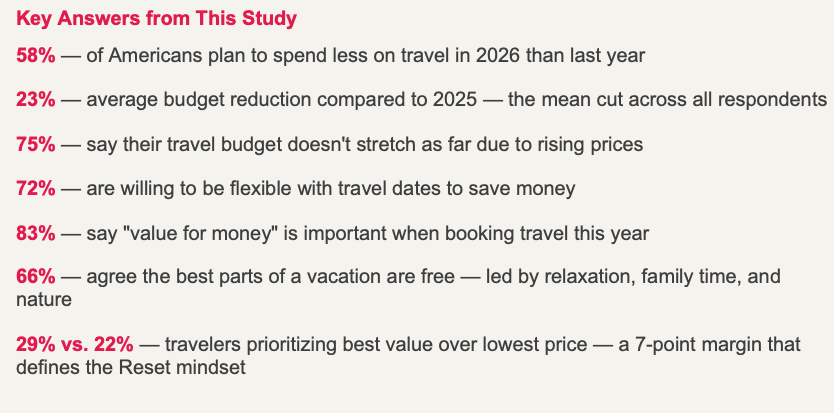
- 58% of Americans plan to spend less on travel in 2026, with budgets down an average of 23% — yet only 9% plan to spend more, and most are staying in the game by spending smarter.
- 75% say higher prices have made their travel budget go less far than it did last year — the single biggest structural pressure behind The Vacation Value Reset.
- 70% are being more careful with money overall in 2026, with 45% directly feeling the impact of rising prices on their daily and travel spending.
- 72% are willing to flex their travel dates to find cheaper fares — making scheduling flexibility the most universally adopted budget strategy.
- 83% say "value for money" is the dominant booking criterion in 2026, with best-value seekers (29%) outnumbering lowest-price hunters (22%).
- 66% agree that the best parts of a vacation are free — pointing to a values realignment in which meaning, not money, defines the ideal trip.
How Much Are Americans Cutting Back on Travel Spending in 2026?
More than half of Americans have already made the call: scale back or spend smarter. The Vacation Value Reset begins here, with a majority of travelers entering 2026 with smaller budgets, higher prices, and no intention of sitting it out.
- 58% — of Americans plan to spend less on travel in 2026 — with the average budget cut sitting at 23% compared to last year
- 75% — say their travel dollar goes less far due to higher prices — more than three times the number who plan to spend more (9%)
- 70% — are being more careful with money overall in 2026 — and among those cutting travel spend, 74% cite general financial caution as the primary driver
Of those scaling back on travel, 38% say circumstances have made them more budget-conscious than they were last year, and 37% need to spend more in other areas — pointing to a squeeze that goes beyond travel preferences and into household economics.
What Are Americans Cutting — And What Are They Keeping?
The clearest window into the Vacation Value Reset is the cutting list. Americans are not trimming trips at random — they are applying a distinct hierarchy: luxury perks go first, meaningful experiences last.
- 42% — say dining out is the first travel expense they cut — followed by shopping and souvenirs (40%) and trip length (33%)
- 44% — are skipping high-end and fine-dining restaurants, 40% are bypassing luxury hotels or resorts, and 35% are cutting spa treatments — the clearest signal of the Reset in action
- 34% — are bringing their own snacks or groceries on trips, making self-catering the single most common travel budget tactic in 2026
- 72% — are willing to be flexible with travel dates to find cheaper flights — flexibility has become the dominant value-optimization behavior
Budget and mid-range accommodations are the accommodation of choice for 27% of travelers, while 35% plan to stay with friends or family to reduce lodging costs. Only 10% say they are choosing all-inclusive resorts as a cost-control strategy — though 10% of travelers do plan to book all-inclusive resort trips this year.
Is the Best Vacation Actually Free?
Perhaps the most striking finding in this study is not what Americans are cutting — it is what they are protecting. When budgets compress, the experiences Americans defend most strongly are the ones that cost nothing.
- 66% — agree the best parts of a vacation are free — with relaxation (59%), time with loved ones (52%), walking on the beach (43%), and enjoying nature (42%) leading the list
- 29% — say getting the best value for the price matters most when planning travel — compared to just 22% who say the lowest price possible is the priority
- 83% — "value for money" is important to 83% of Americans when booking travel in 2026 — making it the clearest single expression of the Vacation Value Reset mindset
This distinction matters. The Vacation Value Reset is not a price war — it is a values war. Brands that can credibly claim value (rather than simply compete on cost) are positioned on the right side of the behavioral shift reshaping American travel in 2026.
Top 10 Ways Americans Are Making Their Travel Budgets Go Further in 2026
- Bring snacks or groceries instead of eating out for every meal (34%)
- Drive instead of flying when possible (28%)
- Take fewer trips per year but make them count (24%)
- Take advantage of free attractions or activities at their destination (22%)
- Look for travel deals or flash sales (21%)
- Travel to visit friends or family to save on lodging (21%)
- Choose budget or mid-range accommodations instead of luxury hotels (20%)
- Shorten the length of the trip (20%)
- Travel during off-peak or shoulder seasons (20%)
- Be flexible with travel dates to find cheaper flights (20%)
Where Can Travelers Get the Best Value in 2026?
The Vacation Value Reset suggests travelers are no longer simply looking for the cheapest possible trip. Instead, Americans are increasingly prioritizing experiences that deliver the strongest overall value for their money while reducing unexpected costs and decision fatigue during travel.
Based on the findings in this study, travelers looking to make their budgets go further in 2026 are most likely to benefit from:
- Flexible travel dates to secure lower fares and better package pricing
- Bundled or all-inclusive travel options that reduce on-trip spending surprises
- Trips centered around relaxation, beach time, nature, and shared experiences rather than luxury upgrades
- Destinations and booking options that provide strong value transparency upfront
- Travel packages that simplify budgeting by including accommodations, food, and entertainment together
The data suggests that in 2026, value is increasingly defined not by spending the least, but by getting the most meaningful experience for the money spent.
Methodology
Talker Research surveyed 2,000 Americans who have access to the internet. The survey was commissioned by CheapCaribbean Vacations and administered and conducted online by Talker Research between March 26–30, 2026. The questionnaire can be found here. To view the complete methodology as part of AAPOR’s Transparency Initiative, please visit the Talker Research Process and Methodology page.
Interpretation
The Vacation Value Reset is not a retreat from travel. It is a renegotiation of its terms. Americans are not canceling vacations; they are reclassifying what makes one worth taking. The data reveals a clear behavioral split: high-cost perks — luxury hotels, fine dining, spa treatments — are the first to go, while high-meaning, low-cost experiences — relaxation, time with loved ones, nature, the beach — are explicitly preserved.
Budgets are down 23% on average, but the desire to travel remains structurally intact. More than half of Americans still plan at least one vacation in 2026, and 72% are actively engineering their trips to make them happen — adjusting dates, bringing their own food, choosing lower-cost destinations, and leaning into free activities. This is not passive acceptance of constraint; it is active optimization.
The most consequential finding may be the value-versus-price split. When asked what matters most, 29% of Americans choose best value over the 22% who want the lowest price. Combined with 83% rating “value for money” as important, the data describes a traveler who is not simply looking for the cheapest option but for the one that delivers the most per dollar spent. The Vacation Value Reset rewards brands that communicate quality and value credibly — and punishes those that compete on headline price alone.
For travel brands, the strategic implication is direct. The traveler of 2026 has not left the market. They have raised the standard for what earns their spend. Brands that can demonstrate genuine value — whether through pricing transparency, all-inclusive simplicity, or experiential credibility — are well-positioned to benefit from the behavioral realignment this Reset represents.
The Vacation Value Reset reframes how Americans justify a booking: the traveler who once asked “can I afford this?” is now asking “is this worth it?” — and brands that bundle genuine value upfront, like all-inclusive packages that eliminate the mental cost of every on-trip decision, are the natural answer to that question.
Related Research: For insights into what finally triggers Americans to book, including last-minute deal behaviour and the Summer Salvage Effect, see our 2026 Summer Salvage Effect study.